NPSH
What is NPSH? A Complete Guide for Pump Engineers
NPSH is one of the most important checks in centrifugal pump engineering. Incorrect understanding of NPSH can lead to cavitation, vibration, seal failures, bearing damage and permanently damaged impellers.
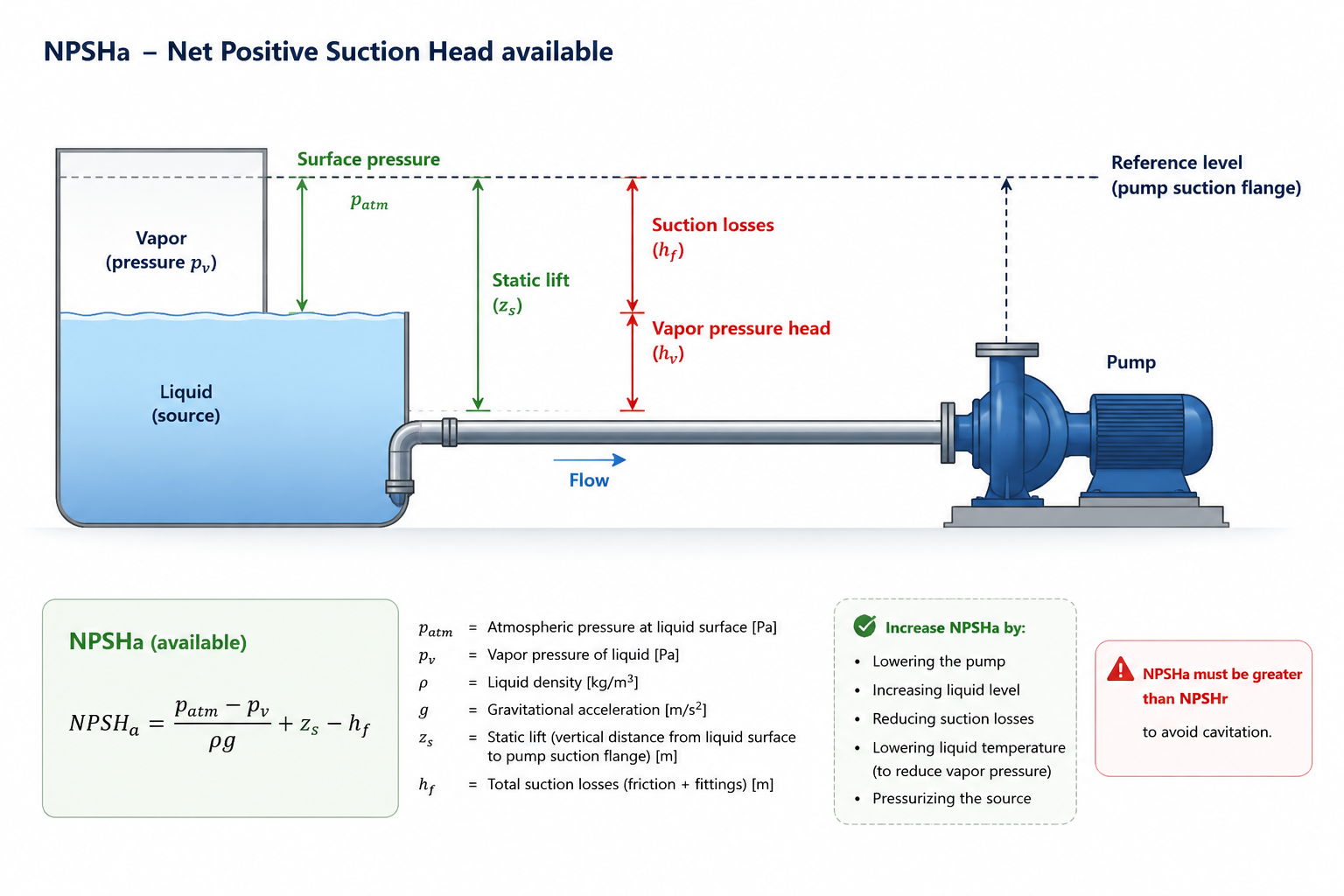
What does NPSH mean?
NPSH means Net Positive Suction Head. It describes how much pressure energy is available at the pump suction above the liquid vapor pressure.
If pressure at the pump suction drops too close to vapor pressure, the liquid starts to boil locally and vapor bubbles form. When these bubbles collapse inside the impeller passages, cavitation occurs.
NPSHa vs NPSHr
There are two different NPSH values. Confusing them is one of the most common mistakes in pump applications.
NPSHa — Available NPSH
NPSHa is provided by the system. It is calculated from actual suction conditions.
- suction vessel pressure,
- liquid level,
- fluid vapor pressure,
- suction line losses,
- fluid density and temperature,
- installation altitude.
NPSHr — Required NPSH
NPSHr is required by the pump. It is determined by pump hydraulic design and testing.
- impeller geometry,
- pump speed,
- flow rate,
- impeller eye diameter,
- suction specific speed,
- inducer or double-suction design.
Basic NPSH condition
For stable pump operation, available NPSH must be higher than required NPSH:
In real engineering practice, this is not enough. A margin is normally required.
What determines NPSHa?
1. Suction tank pressure
Higher suction vessel pressure increases NPSHa. Pressurized tanks, deaerators or elevated condensate tanks can improve suction conditions. Vacuum service reduces NPSHa significantly.
2. Static liquid level
A higher liquid level above the pump centerline improves NPSHa. A flooded suction arrangement is generally better than suction lift.
3. Vapor pressure
Higher vapor pressure reduces NPSHa. Vapor pressure increases strongly with temperature, which is why hot water, condensate, hydrocarbons and flashing liquids are often NPSH-critical.
4. Suction piping losses
Friction losses in the suction line reduce NPSHa. Common causes include undersized suction pipe, long suction piping, too many fittings, clogged strainers, partially closed valves and high suction velocity.
5. Altitude
Higher installation altitude reduces atmospheric pressure and therefore reduces NPSHa. This is especially relevant for open suction tanks.
What determines NPSHr?
1. Pump speed
Higher rotational speed generally increases NPSHr. High-speed pumps and compact designs are therefore often more demanding on suction conditions.
2. Flow rate
NPSHr normally increases with flow. The highest NPSHr is often close to runout conditions, not necessarily at rated flow.
3. Impeller design
Larger impeller eye diameter, double-suction impellers and inducers can improve suction performance and reduce NPSHr.
4. Suction specific speed
Higher suction specific speed can indicate improved suction capability, but very high values may also bring instability risks such as suction recirculation and vibration sensitivity.
Typical NPSH margin
NPSH margin depends on project practice, end-user specification and service criticality. Typical preliminary guidance:
| Service | Typical NPSH Margin | Comment |
|---|---|---|
| General industrial service | NPSHa ≥ 1.1–1.3 × NPSHr | Common preliminary check |
| Critical process pumps | NPSHa ≥ 1.3–1.5 × NPSHr | Often required by project/end user |
| Hot water / condensate | Often higher margin | Strong vapor pressure sensitivity |
| API / refinery service | Project-specific | Check datasheet and purchaser specification |
NPSH3 and why margin is needed
Manufacturers commonly define NPSHr using NPSH3. This is the NPSH value at which pump total head drops by 3% during testing.
Important: cavitation usually starts before the 3% head drop point. Noise, vibration and vapor bubbles may already exist before the pump reaches official NPSHr. This is why NPSH margin is necessary.
When should NPSH be tested?
NPSH testing is commonly required for critical applications and demanding specifications, especially where suction conditions are close to the pump requirement.
Typical cases include:
- API 610 pumps,
- refinery and petrochemical projects,
- condensate pumps,
- boiler feed or hot water services,
- low-NPSH applications,
- critical process pumps,
- new hydraulic design or low-margin selection.
During a test, suction pressure is gradually reduced until the specified head drop criterion is reached, commonly 3% head drop. The resulting value is then reported as NPSHr / NPSH3 for the tested flow point.
What can cause insufficient NPSHa?
System causes
- low suction liquid level,
- pump installed too high,
- long suction pipe,
- small suction pipe diameter,
- clogged strainer,
- partially closed suction valve,
- too many elbows near suction.
Process causes
- higher operating temperature,
- wrong vapor pressure assumption,
- wrong density assumption,
- air ingress,
- unexpected flow increase,
- operation near runout,
- flashing liquid conditions.
Typical cavitation symptoms
- gravel-like noise,
- crackling sound from pump casing,
- increased vibration,
- unstable flow,
- power fluctuations,
- seal leakage,
- bearing overheating,
- impeller pitting,
- capacity reduction,
- head drop.
How to improve NPSHa
- increase suction pipe diameter,
- reduce suction line length,
- remove unnecessary fittings,
- clean or enlarge suction strainer,
- lower pump elevation,
- increase liquid level,
- increase suction vessel pressure,
- reduce liquid temperature,
- avoid high suction velocity.
How to reduce NPSHr
- select lower-speed pump,
- select larger pump size,
- select better suction hydraulics,
- use larger impeller eye design,
- use double-suction impeller,
- consider inducer where appropriate,
- avoid operation far beyond rated flow.
API 610 perspective
In API 610 projects, NPSH is often treated more strictly than in general industrial applications. Purchaser specifications may define required NPSH margin, test requirements, rated point requirements and acceptable NPSH3 behavior.
Particular attention is usually required for condensate service, hot hydrocarbons, vacuum tower bottoms, flashing liquids and any service where available suction head is limited.
Final thoughts
NPSH is not only a datasheet value. It is a key reliability parameter. A technically correct NPSH evaluation requires understanding system losses, vapor pressure, pump hydraulics and real operating conditions.
Ignoring NPSH margin can lead to cavitation, vibration, premature failures and expensive shutdowns. Proper NPSH analysis is therefore essential for every serious pump engineering project.